Destination
Sailing the Lyngen Alps
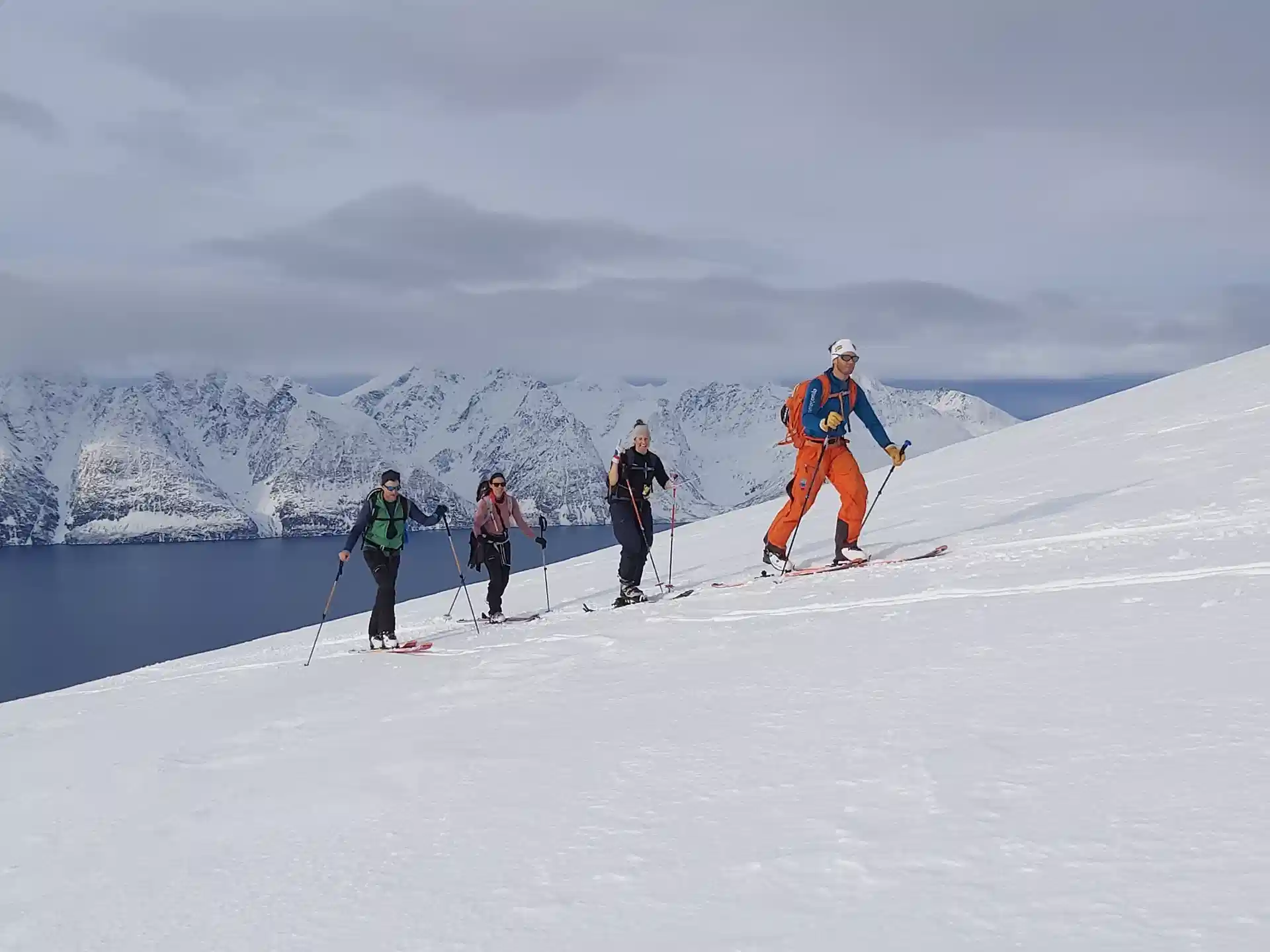
The Lyngen Alps are a 90-kilometre chain of peaks north-east of Tromsø, rising directly from the Lyngenfjord. Because the mountains start at sea level, a yacht can anchor below routes that have no road and no lift. Ski touring runs from late February to early May; trekking runs from June to September.
At a glance
| Location | Lyngenfjord and Ullsfjord, Troms, Northern Norway |
|---|---|
| Coordinates | 69.6°N, 20.2°E |
| Best season | Late February to early May for ski touring; June to September for trekking |
| Sailing time from Tromsø | Two to five hours from Tromsø, depending on the anchorage |
| Known for | Sea-to-summit ski touring, glaciated peaks, sheltered fjord water |
| Typical experiences | Ski & Sail Norway, Lyngen Ski & Sail, Sail & Trek, private charter |
Why sail here
Where do the mountains begin in the Lyngen Alps?
The mountains of the Lyngen peninsula begin at the waterline itself: a wall of rock and ice between two fjords, with more than 80 summits above 1,200 metres and the highest, Jiekkevarri, reaching 1,833 metres. There is almost no flat land between the summits and the sea, which is exactly why the range works from a boat.
Ascents here typically gain between 800 and 1,400 metres and start at the tide line. You step from the tender onto the shore, put skins on, and begin climbing. There is no drive-in, no car park, and on most of the peninsula no road at all on the eastern side.
On foot in summer the same geography applies. Ridges and valleys that would take a long approach from the road end are 20 minutes from an anchorage.
How does the boat solve Lyngen's weather problem?
The boat solves Lyngen's weather problem by moving overnight to wherever conditions are best. Snow and weather here are local: a slope scoured by wind on Monday can be settled by Thursday, and a fjord 20 nautical miles away can be sheltered when the one you are in is not. A road-based week has to accept whatever sits above the hotel.
The skipper and the guide read the forecast together each evening and choose where the boat sits at breakfast. That single decision is the practical argument for sailing to ski, and it is why Ski & Sail weeks lose fewer days to weather than land-based ones.
The yacht is also the drying room, the kitchen and the transport. Gear stays in one place for the week. There is no repacking and no minibus transfer.
How sheltered is the sailing between anchorages in Lyngen?
Lyngenfjord and Ullsfjord are sheltered inshore water, protected from the open Atlantic by Kvaløya, Ringvassøya and the outer islands, and passages between anchorages are usually one to three hours. Guests who are not sailors rarely find the motion difficult.
Tromsø is the departure point for every Lyngen voyage. The city has direct flights from Oslo and seasonal European connections, so the sailing starts within a couple of hours of landing.
When to go
Lyngen has two clear seasons for guests, separated by a quiet shoulder period. This is what each looks like from the deck.
Late February to early May — ski touring
The core Ski & Sail season. Late February gives roughly nine hours of daylight, growing to more than 18 hours by early May, so the days lengthen sharply through the season.
March and April usually hold the most settled snow. Temperatures at sea level sit near freezing, colder at altitude, and the fjord water stays open all winter.
Late April and early May bring corn snow and long evenings. Guests who prefer warmth over powder tend to choose this end of the season.
June to August — midnight sun and trekking
The sun does not set in Tromsø and Lyngen between roughly 20 May and 22 July. There is no darkness at all, which changes how a day is planned — a summit walk can start at 21:00.
Snow lingers on the high ground into July. Valley walking, ridge lines and glacier viewpoints are the summer terrain, with sea temperatures around 8 to 12°C.
Weather is milder but not warm. Expect 8 to 16°C at sea level and rain on some days.
September to November — quiet season
Autumn colour on the tundra, first snow on the peaks, and the return of darkness. The northern lights become visible again from late August.
Sailing continues, but the mountain programme is limited. Most guests in this period are on charter rather than a fixed ski or trekking week.
December to mid-February — polar night and after
The sun stays below the horizon in Tromsø from 27 November to 15 January, leaving several hours of blue twilight each day.
Lyngen is sailed in this period mainly on winter cruises and northern lights voyages rather than ski weeks. Serious ski touring starts once the light returns.
Good to know
Is avalanche terrain a risk in the Lyngen Alps?
Yes. Lyngen is serious mountain terrain and avalanches are a real hazard through the ski season. Every ski week runs with a certified mountain guide who checks the regional forecast each morning and makes the terrain decisions. Every guest carries a transceiver, shovel and probe.
How fit do you need to be for Lyngen ski touring?
You should be comfortable ascending around 900 vertical metres on skins over a four- to eight-hour ski day, including the descent. Summer trekking days are shorter and can be adjusted to the group.
How remote is the eastern side of the Lyngen peninsula?
The eastern side of the peninsula has few settlements and limited mobile coverage in places. Boreal Yachting's vessels carry satellite communication, and the skipper files a plan each day. The nearest hospital is in Tromsø.
What are the right-of-access rules in Norway?
Norway's allemannsretten gives everyone the right to walk and camp on uncultivated land, with the obligation to leave no trace. Boreal Yachting anchors away from settlements, carries all waste back to Tromsø, and keeps distance from reindeer herds and nesting birds.
Questions guests ask
- How far is Lyngen from Tromsø by boat?
- Two to five hours of sailing, depending on which anchorage we are heading for. Most Ski & Sail weeks leave Tromsø in the evening of the first day and are below a mountain at breakfast.
- Do I need to be a sailor to join?
- No. The crew handles the boat. Guests who want to steer, take a watch or help with the sails are welcome to; guests who prefer to sleep through the passage do that instead.
- When is the snow best in the Lyngen Alps?
- March and April are usually the most reliable. February can be cold and dark early in the month, and by May the snow turns to spring corn, which many skiers prefer.
- Can we sail Lyngen in summer?
- Yes. From June to September we sail the same fjords for trekking, ridge walks and midnight sun cruising. The mountains are the same; the approach is on foot rather than skins.
- Is Lyngen sold per person?
- No. We sell the whole boat. A group takes the vessel and the crew for the week, whether that group is four people or eight.
Start planning your Arctic journey.
Tell us what you have in mind. We will come back to you within two working days with a considered answer — not a template.