Destination
Sailing Lofoten
Lofoten is an archipelago off the coast of Nordland, where granite peaks rise abruptly from the Atlantic. Its harbours and anchorages face the open sea, which makes arriving by boat the natural approach. Best sailed from June to September, with a ski touring season from March to May.
At a glance
| Location | Lofoten archipelago, Nordland, Northern Norway |
|---|---|
| Coordinates | 68.2°N, 13.6°E |
| Best season | June to September for sailing and trekking; March to May for ski touring |
| Sailing time from Tromsø | Around 24 hours from Tromsø, usually broken by a stop in Senja or Vesterålen |
| Known for | Granite peaks, fishing villages, white beaches, exposed Atlantic coast |
| Typical experiences | Sail & Trek, private charter, group charter, bareboat charter |
Why sail here
Why is Lofoten better explored by boat?
Lofoten is better explored by boat because the road runs along only one side of the archipelago. This thin chain of islands, roughly 160 kilometres long with mountains up to 1,160 metres rising directly from sea level, keeps its north-facing bays, outer islets and untracked beaches reachable only by water.
In summer the villages on the road are busy. The anchorages a few nautical miles away are not. Arriving by boat is the difference between visiting Lofoten and having it to yourself in the evening.
Where do Lofoten's walks start?
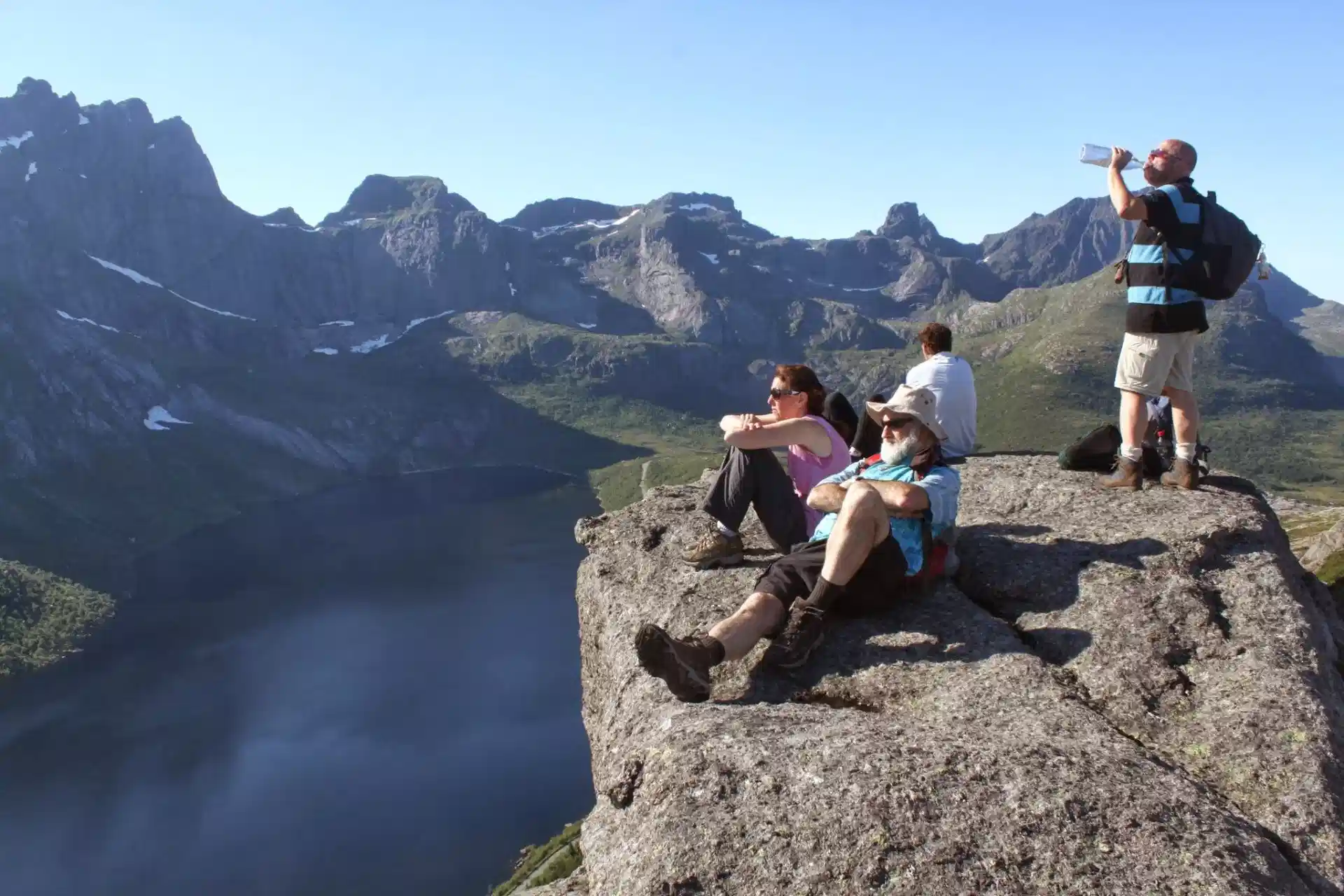
Lofoten's walks start at the tide line, on peaks that are steep and short. A summit that takes three hours from the water gives a view over both the Vestfjord and the open Atlantic. Groups usually walk in the morning, sail in the afternoon, and anchor somewhere new.
Because the boat carries everything, a walking week here needs no logistics at all — no hire car, no accommodation chain, no fixed schedule to keep.
Which places should you visit in Lofoten?
The stops worth building a week around are Svolvær, Henningsvær, Reine, Nusfjord and, if the sea allows, the outer islands of Røst and Værøy. Svolvær is the practical hub, with the twin horns of Svolværgeita above the town and a well-equipped harbour.
Henningsvær is built across small islands linked by bridges, with 500 residents, the Kaviarfactory gallery and the football pitch on a rocky outcrop that appears in every photograph of Lofoten. Reine sits below the jagged peaks of Moskenesøya and looks better from the water than in any picture of it. Nusfjord is a protected nineteenth-century fishing village entered between vertical cliffs.
Røst and Værøy, at the south-western tip of the chain, hold the largest seabird colonies in Scandinavia — puffins in their hundreds of thousands, with razorbills, guillemots and gannets. It is most of a day's sail from Svolvær and depends on the sea state, which is exactly why so few visitors get there.
What does a week in Lofoten look like?
A classic week works through the archipelago rather than around it: Stamsund, Henningsvær, Svolvær, Kabelvåg, Skrova and the Trollfjord, a two-kilometre cleft with vertical rock on both sides. Distances between stops are short, so most days hold a passage and a walk.
The named peaks — Reinebringen, Munkebu, Svolværgeita — are steep and quick, and the boat can anchor below the trailhead so a summit fits into an afternoon. In spring the same terrain is skied from the summit back down to the water.
What is there to fish and to see?
Cod, halibut and saithe are caught from the boat through the season, and king crab in its months. A good number of guests eat what they catch, which is part of why the galley plan here stays loose.
Sea eagles are common along the coastline, puffins nest on the outer islands, and from autumn into winter orca and humpback whales follow the herring into the Vestfjord.
Is the sailing in Lofoten exposed?
Yes. Unlike Lyngen, Lofoten sits on the exposed coast, and the Vestfjord crossing and the western side of the chain feel like ocean sailing, with swell and stronger wind. For guests who want to sail rather than motor between fjords, this is the ground for it.
It also means the weather has more say. Routes here are planned with alternatives, and the skipper will change the plan rather than push into a bad forecast.
When to go
Lofoten sits a degree and a half south of Tromsø, so its seasons are close to ours but a little milder.
March to May — ski touring and light
Snow on the peaks with the sea below and rapidly lengthening days. Steep, short descents that end at the water.
Weather is more Atlantic than in Lyngen, so ski weeks here depend more on the forecast.
June to July — midnight sun
The sun does not set from roughly 26 May to 17 July. Long walking days, warm rock and quiet anchorages once the day visitors have left.
Air temperatures of 10 to 18°C. The best sailing conditions of the year.
August to September — late summer
Darkness returns, and with it the first aurora of the season over the peaks. Fewer visitors ashore.
More wind and rain than midsummer, but good visibility between systems and excellent light for photography.
October to February — winter
Short days or none at all, hard weather on the outer coast, and the winter cod fishery under way in the Vestfjord.
We sail Lofoten in this period only on longer charters with experienced groups.
Good to know
Exposure
Lofoten is open Atlantic coast. Crossings can be lively, and the route will be adjusted around weather. Guests prone to seasickness should say so before departure so we can plan the passages accordingly.
Getting there
Most voyages sail from Tromsø, which takes around 24 hours and is usually broken by an overnight stop. Groups with less time can join or leave in Svolvær; there are flights via Bodø. Boats working the Lofoten season also operate from Harstad, served by Harstad/Narvik Airport (EVE) with direct flights from Oslo in about 1h45m, and Harstad is roughly 45 minutes by boat from Svolvær.
Busy ashore, quiet on the water
The main villages see heavy summer tourism. We plan around it, using anchorages rather than harbours where we can and going ashore outside peak hours.
Bareboat charter
Lofoten is a common bareboat destination for qualified sailors, but it is not a beginner's cruising ground. We ask for documented experience and a sailing CV before confirming a bareboat booking.
Questions guests ask
- How long does it take to sail from Tromsø to Lofoten?
- Around 24 hours of sailing, normally split across two days with a stop in Senja or Vesterålen. A one-way Tromsø to Lofoten voyage suits a week.
- Is Lofoten better by boat than by car?
- For the coastline, yes. The road reaches one side of the islands. The bays, islets and beaches without tracks are only reachable by water, and the anchorages are empty in the evening.
- What is the best month to sail Lofoten?
- June and July for daylight and settled weather, late August and September for autumn light and the first aurora. March to May for ski touring.
- Which walks in Lofoten start from the boat?
- Reinebringen, Munkebu and the ridges above Henningsvær all begin close to the water, and the boat can anchor below the trailhead. Most are three to five hours return, so a summit and a passage fit into the same day.
- Can we fish from the boat in Lofoten?
- Yes. Cod, halibut and saithe are caught through the season, with king crab in its months, and guests regularly eat what they catch. Gear is aboard and the crew will show you the grounds.
- Can we charter a boat in Lofoten without a skipper?
- Yes, if you hold the qualifications and experience for the conditions. We review a sailing CV before confirming a bareboat charter.
Start planning your Arctic journey.
Tell us what you have in mind. We will come back to you within two working days with a considered answer — not a template.