Destination
Sailing from Tromsø
Tromsø sits at 69.6°N, inside the auroral oval and above the Arctic Circle, with an ice-free harbour and direct flights from Oslo. It is our home port and the departure point for almost every voyage. Northern lights sailing runs from September to March; midnight sun sailing from late May to July.
At a glance
| Location | Troms, Northern Norway. Boreal Yachting's home port |
|---|---|
| Coordinates | 69.6°N, 18.9°E |
| Best season | Year-round; aurora September to March, midnight sun late May to July |
| Sailing time from Tromsø | Departure point — one to five hours to most anchorages |
| Known for | The auroral oval, whale grounds, island fjords, an ice-free winter harbour |
| Typical experiences | Northern Lights Sailing, Whale Sailing, Winter Cruise, Ski & Sail Norway |
Why sail here
Why is Tromsø ice-free all winter?
Tromsø's harbour stays ice-free all winter because it is warmed by the North Atlantic Current. The city also has around 78,000 residents, a university, a hospital and an airport with direct flights from Oslo and seasonal European connections. That combination — full infrastructure at 69.6°N with year-round open water — is unusual, and it is why Boreal Yachting is based here.
For guests it means the sailing starts the day you land. There is no long transfer, no domestic hop to a smaller port. You leave the airport and are on board within the hour.
Why sail out of Tromsø to see the northern lights?
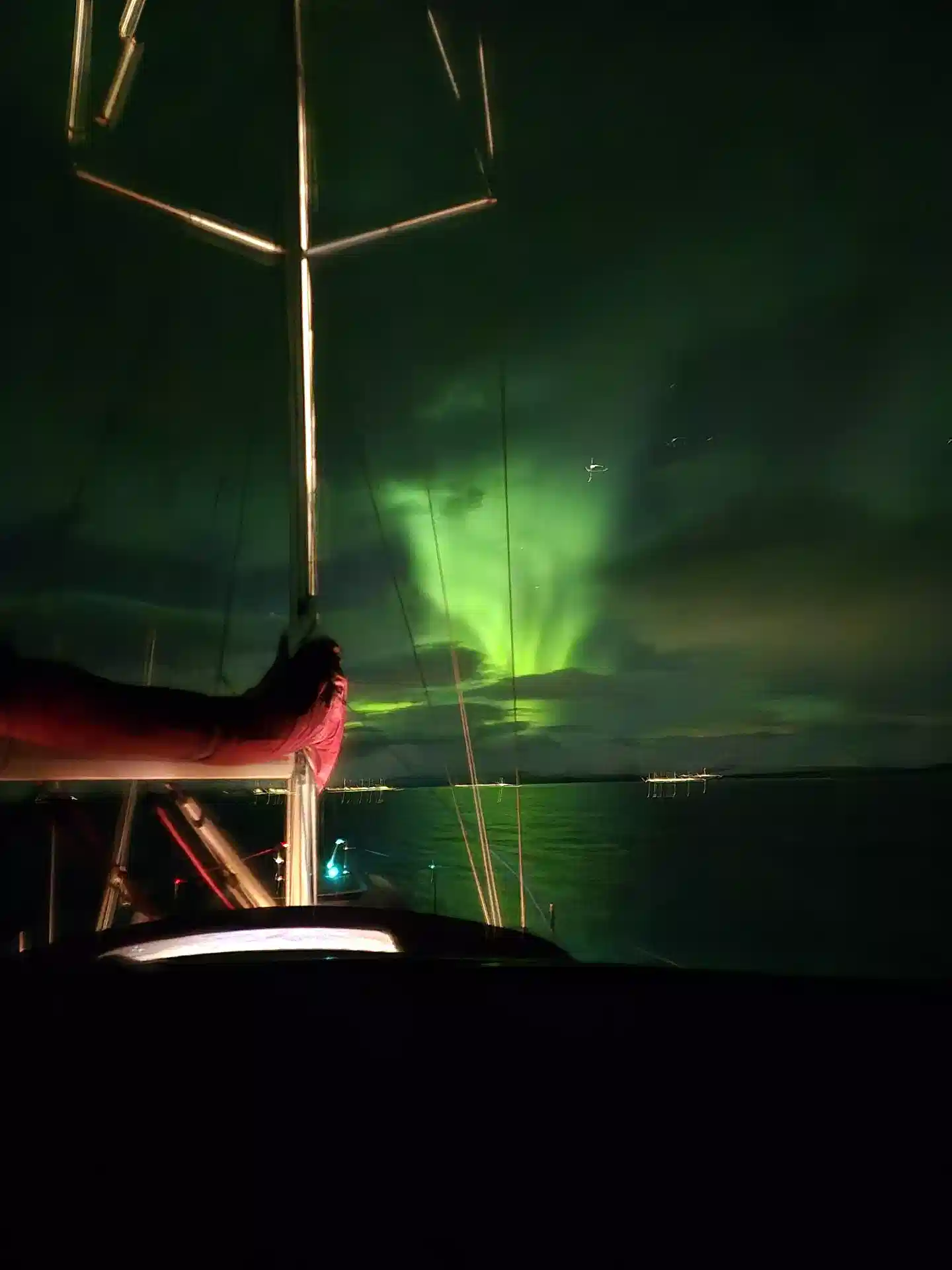
Sailing out of Tromsø gives access to real darkness, which street lighting in the city washes out. Tromsø sits under the auroral oval, the ring where aurora activity concentrates, but even the strongest displays are dimmed by town lights.
A boat solves that in an hour. We sail into a fjord with no road along it, drop anchor, turn off the deck lights, and wait. There is no coach, no set finishing time and no crowd at the viewpoint. When the sky opens, you are already where you need to be, and you can stay until it closes again.
What is within reach of Tromsø's harbour?
The islands and fjords around Tromsø — Kvaløya, Ringvassøya, Ullsfjord, Balsfjord — are within one to five hours of the harbour. Lyngen is a half day, Senja a night's sail, and Vesterålen and Lofoten are within reach on a week-long voyage.
That makes Tromsø the natural base for whole-boat weeks that combine several areas, and it means a voyage can move when the weather does rather than commit to one fjord.
When to go
Tromsø is a year-round port, but the four seasons here are strikingly different from one another.
September to mid-November — aurora and autumn
Darkness returns properly from early September, and the aurora season opens. Autumn colour on the birch slopes, mild sea temperatures and few visitors.
Weather is unsettled, with more wind and rain than midwinter. Good sailing, and the best value period of the year.
Late November to mid-January — polar night
The sun stays below the horizon from 27 November to 15 January. Instead of darkness there are several hours of blue twilight in the middle of the day, which photographers value.
Aurora activity can be seen from early afternoon. Air temperatures usually sit between −8 and +2°C, and the harbour stays ice-free.
Mid-January to April — light returns, then ski season
Daylight comes back quickly, gaining around 20 minutes a day through February. Aurora nights continue until the sky brightens in April.
From late February the Ski & Sail season runs in Lyngen and the fjords north of the city. Snow reaches the shoreline.
Late May to July — midnight sun
The sun does not set between roughly 20 May and 22 July. Sailing continues through the night, and a summit walk can start at 21:00.
Air temperatures at sea level are 8 to 16°C, the sea 8 to 12°C. Whale grounds are quiet in summer, but the light more than compensates.
Good to know
Getting here
Tromsø Airport is four kilometres from the city centre, with direct flights from Oslo throughout the year and seasonal routes from several European cities. We recommend arriving the day before departure, particularly in winter.
Winter conditions
The harbour is ice-free all winter, but it is dark, and it can be windy. Days at sea are short in December and January. Guests need proper cold-weather clothing; the vessels have heated interiors and drying space.
The aurora is not guaranteed
The northern lights depend on solar activity and cloud cover. Sailing improves the odds considerably, because we can move to clearer sky and wait in the dark, but nobody can promise a display on a given night. Voyages of several nights raise the chance substantially.
Whales come and go
Herring-following humpback and orca have wintered in the fjords around Tromsø in some years and moved elsewhere in others. We follow current sightings and the guidance for keeping distance rather than promising an encounter.
Questions guests ask
- Why sail from Tromsø rather than watch the aurora from land?
- Because the boat gets you away from street lighting and lets you stay out. We anchor in a dark fjord with no road along it and wait for as long as the sky is worth watching.
- When is the aurora season in Tromsø?
- From early September to late March, when the nights are dark enough. The strongest months in our experience are September to October and February to March, when the weather is often more workable.
- Is it cold on board in winter?
- The vessels have heated interiors and drying space, so life below deck is comfortable. On deck, you dress for it. We send a clothing list before departure.
- How long should a voyage from Tromsø be?
- Three nights is the shortest that makes sense for aurora or whales. A week allows Lyngen, Senja or a longer coastal route and is what most groups choose.
- Can individuals book places on a departure?
- No. We sell the whole boat, to private groups and through travel partners. Smaller groups are welcome — the boat is still yours.
Start planning your Arctic journey.
Tell us what you have in mind. We will come back to you within two working days with a considered answer — not a template.