Destination
Sailing Vesterålen
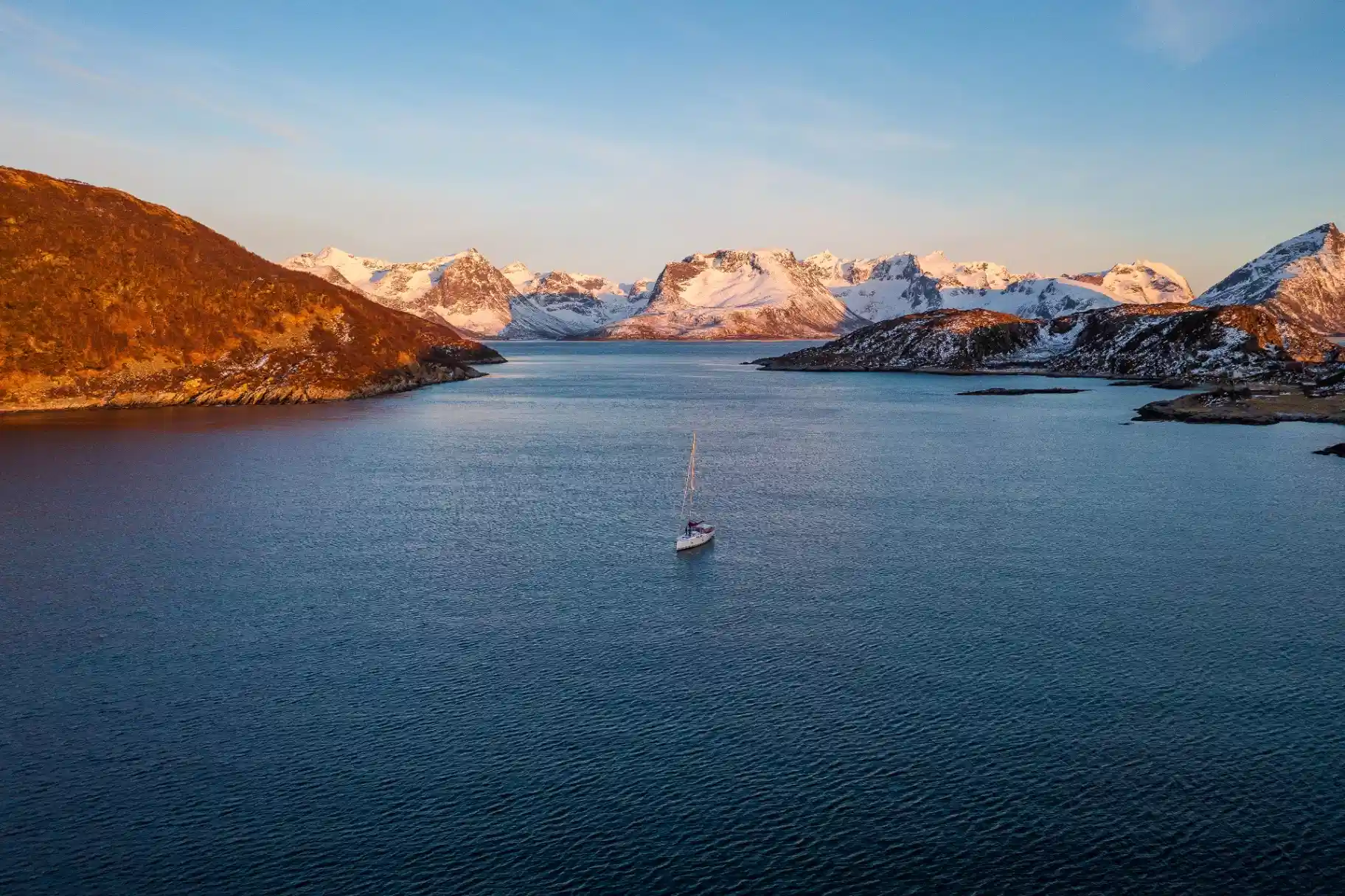
Vesterålen is the group of islands between Senja and Lofoten. Its landscape is broader and gentler than Lofoten's, and the continental shelf edge off Andøya brings deep water and feeding whales close to shore. Best sailed from June to September, on the way south or north.
At a glance
| Location | Vesterålen islands, Nordland, between Senja and Lofoten |
|---|---|
| Coordinates | 68.9°N, 15.2°E |
| Best season | June to September; whale activity strongest late summer and autumn |
| Sailing time from Tromsø | Around 18 hours from Tromsø, or half a day from Senja |
| Known for | Sperm whale grounds off Andøya, wide fjords, working fishing harbours |
| Typical experiences | Whale Sailing, Sail & Trek, private charter |
Why sail here
Why are whales found so close to shore off Andøya?
Whales are found close to shore off Andøya because the continental shelf drops away only a few nautical miles from land, into the Bleik Canyon. That depth brings squid, and squid brings sperm whales, which feed here through the summer. Few places in Europe put water this deep this close to a harbour.
For a sailing yacht it means whale grounds are reachable without a long offshore passage, and the boat can stay quietly on station rather than run a schedule.
Is Vesterålen quieter than Lofoten?
Yes. Vesterålen has the same geology as Lofoten but a broader landscape — wider fjords, gentler hills, more farmland — and a fraction of the visitors, with harbours that are working fishing ports rather than tourist villages.
That makes it a good stretch for guests who want the coast without the crowds, and a comfortable link in a longer voyage between Tromsø and Lofoten.
When to go
Vesterålen is usually sailed as part of a longer coastal voyage. These are the periods that suit it.
June to July
Midnight sun until around 17 July. Settled conditions, warm days ashore and long evenings on deck.
Sperm whales are present off Andøya through the summer.
August to September
The strongest period for whale activity, and the return of darkness brings the first aurora from late August.
Autumn weather is less settled, with more wind from the west.
October to March
Herring wintering patterns have shifted along this coast in recent years, so winter whale activity varies year to year.
We sail here in winter on charter rather than on a fixed programme.
April to May
Snow still on the tops, light returning fast, and very few boats out. A good period for a quiet coastal passage.
Good to know
Wildlife distance
We follow Norwegian guidance on approaching marine mammals: no pursuit, no cutting across a track, engine noise kept down, and we leave if an animal shows disturbance. Sightings are never promised.
Exposure
The western coast of Andøya and the crossing toward Lofoten are open water. Passages are planned around the forecast and can be rerouted inside the islands when it blows.
Harbours
Ports here are working fishing harbours. They are practical rather than picturesque, which is part of the appeal, and they give reliable shelter and provisioning.
Questions guests ask
- Where are the whales in Vesterålen?
- Off Andøya, where the Bleik Canyon brings deep water close to shore. Sperm whales feed there through the summer, and other species pass through at different times of year.
- Is Vesterålen worth sailing if we are going to Lofoten?
- Yes. It is on the way, it is far quieter, and it gives access to whale grounds that Lofoten does not have.
- How long is the sail from Tromsø?
- Around 18 hours direct, more usually broken with a stop on Senja. Most groups sail it as part of a week-long voyage.
Start planning your Arctic journey.
Tell us what you have in mind. We will come back to you within two working days with a considered answer — not a template.