Destination
Sailing Svalbard
Svalbard is a Norwegian archipelago between 74° and 81°N, roughly midway between mainland Norway and the North Pole. Most of it has no roads, so a yacht is the practical way to reach its glacier fronts and wildlife coasts. The sailing season runs from May to September, in continuous daylight.
At a glance
| Location | Svalbard archipelago, Norway. Voyages begin and end in Longyearbyen |
|---|---|
| Coordinates | 78.2°N, 15.6°E (Longyearbyen) |
| Best season | May to September; sea ice and light decide the exact window |
| Sailing time from Tromsø | Flown, not sailed, from the mainland — three hours from Oslo via Tromsø |
| Known for | Tidewater glaciers, polar bears, walrus, seabird cliffs, 24-hour daylight |
| Typical experiences | Summer Svalbard Expeditions, Ski & Sail Svalbard, private charter |
Why sail here
Why does Svalbard have almost no roads?
Svalbard has almost no roads because settlement is confined to a handful of valleys: around 40 kilometres of road in total, nearly all of it inside Longyearbyen. Everything beyond the valley is reached by boat, snowmobile or ski. In summer, that means a vessel.
The archipelago is cut by long fjords — Isfjorden, Kongsfjorden, Liefdefjorden, Hornsund — that run deep into the interior and end at glacier fronts. A yacht can enter them, anchor, and stay. The coastline it opens up is measured in hundreds of kilometres and holds fewer than 3,000 people in total.
Why sail Svalbard in a small vessel?
A small sailing yacht carries a small group, draws little water and makes little noise, so it can hold position at a safe distance from a glacier front, work into shallow bays that expedition ships cannot enter, and change plan the same morning if the ice or the wildlife suggests it.
That flexibility is the whole point of sailing here. Wildlife in Svalbard is not scheduled. A walrus haul-out, a bear on a beach, a beluga pod in a fjord mouth — none of it appears on an itinerary. A small boat can respond to it within the rules; a fixed schedule cannot.
It also means the number of people ashore at any site stays low, which is what the AECO guidelines are designed to achieve.
What decides the route in Svalbard?
Sea ice decides the route in Svalbard: it governs how far north and east a voyage can go, and it varies year to year. Early season voyages often stay in the west and south of Spitsbergen; by August the north coast is usually open, and circumnavigation is sometimes possible in late summer.
We publish a route intention, not a promise. The skipper decides each day based on ice charts, weather and wildlife. Guests who need a fixed itinerary will find Svalbard frustrating; guests who want the real thing usually find this is the best part of it.
When to go
Svalbard has a short, sharply defined season. Each month within it is genuinely different.
March to early May — ski touring season
The sun returns in March and daylight grows quickly. The land is still snow-covered and the fjords may hold fast ice.
This is the Ski & Sail Svalbard window: skiing from the boat onto snow that reaches the shoreline, in temperatures that regularly sit between −10 and −20°C.
Late May to June — early summer
The midnight sun runs from around 20 April to 22 August, so there is no darkness at all in this period.
Snow still lies low on the mountains, the light is hard and clear, and there are few other vessels. Ice can restrict the north and east.
Seabird colonies fill up. Little auks, kittiwakes and guillemots arrive in enormous numbers.
July to mid-August — high season
The most open water of the year, and the widest choice of route. Temperatures in the fjords sit around 3 to 8°C.
Best chance of reaching the north coast and the pack ice edge. Walrus haul-outs are active, and glacier fronts calve steadily in the warmth.
Late August to September — late season
Darkness returns from late August, and with it the first chance of northern lights over the fjords.
Autumn colour appears on the tundra, wildlife is active before winter, and there are very few boats left. Weather is less settled and the season closes as the ice re-forms.
Experiences here
Experience
Summer Svalbard Expeditions
June to end-September
Experience
Ski & Sail Svalbard
May to mid June
Experience
Private Charter
All year, with different regions by season
The vessel
Aleiga
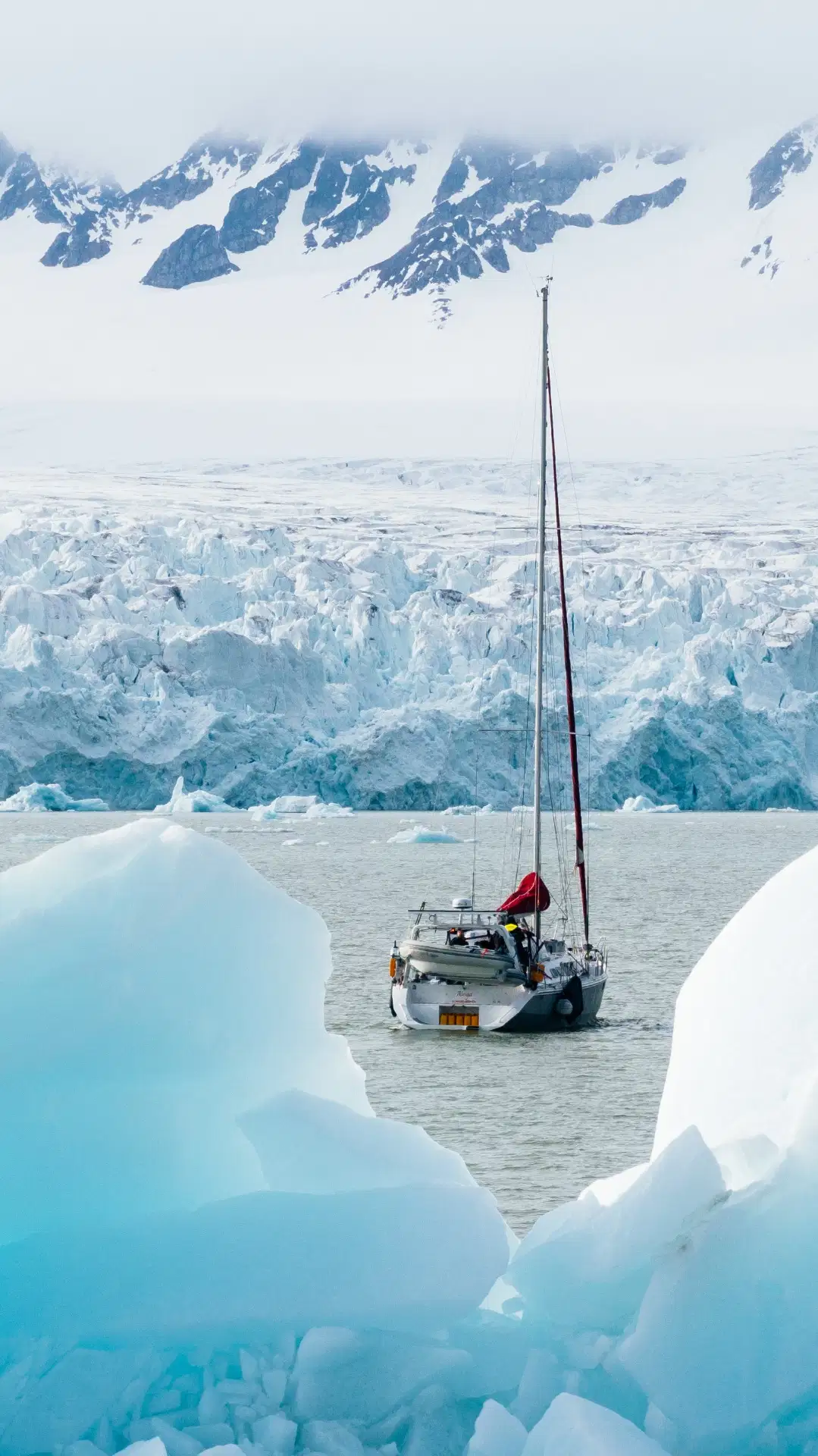
Aleiga is our Svalbard vessel: an aluminium OVNI 455 with a lifting keel and an insulated hull, based in Tromsø and operating in Svalbard from May to September.
Good to know
Regulations
Svalbard is governed by Norwegian environmental law and administered by Sysselmesteren på Svalbard, the Governor of Svalbard. Voyages must be notified in advance, insurance for search and rescue is required, and there are protected areas, landing rules and minimum distances from wildlife. We handle the notification and permit work as the operator.
AECO guidelines
Boreal Yachting is a member of AECO, the Association of Arctic Expedition Cruise Operators. We operate to its guidelines on wildlife distance, site-specific behaviour, cultural heritage and biosecurity. Guests receive a briefing on these rules before the first landing.
Polar bears
Polar bears are present across the archipelago and are a genuine hazard, not an attraction to approach. A trained guide with a firearm accompanies every landing, as Norwegian rules require. Approaching, attracting or disturbing a bear is illegal.
Remoteness and rescue
There is no coastguard station within easy reach of most anchorages, and help can be many hours away. Our vessels carry satellite communication, survival equipment and medical supplies, and the crew is trained for the environment. Guests need travel insurance that covers remote Arctic evacuation.
Getting there
Longyearbyen has daily flights from Oslo, most routed via Tromsø. Voyages begin and end at the quay in Longyearbyen. We recommend arriving a day early — a missed connection cannot be caught up with.
Cold, even in July
Summer temperatures in the fjords sit between 3 and 8°C, and the wind off a glacier is colder still. Proper layers, a waterproof shell and warm boots are not optional.
Questions guests ask
- When can you sail in Svalbard?
- The sailing season runs from roughly May to September. Ski touring from the boat runs earlier, from March to early May. Sea ice decides how far north and east any given voyage can reach.
- Will we see polar bears?
- Often, but never guaranteed. Bears are wild animals across an archipelago the size of Ireland. We keep the legal distance and watch from the vessel or from a safe position ashore.
- Do we need a guide with a firearm?
- Yes. Norwegian regulations require adequate protection against polar bears outside settlements, and every landing is accompanied by a trained guide who carries a firearm.
- Is Svalbard suitable for people who have never sailed?
- Yes. Most of our guests are not sailors. The crew runs the vessel. What Svalbard does ask for is tolerance of cold, of changing plans, and of long days outdoors.
- Can the itinerary change?
- It usually does. Ice, weather and wildlife decide the route day by day. We publish an intended route and adjust it as conditions require.
- Do you sell single berths to Svalbard?
- No. Every voyage is sold as a whole boat, to a private group or through a travel partner.
Start planning your Arctic journey.
Tell us what you have in mind. We will come back to you within two working days with a considered answer — not a template.