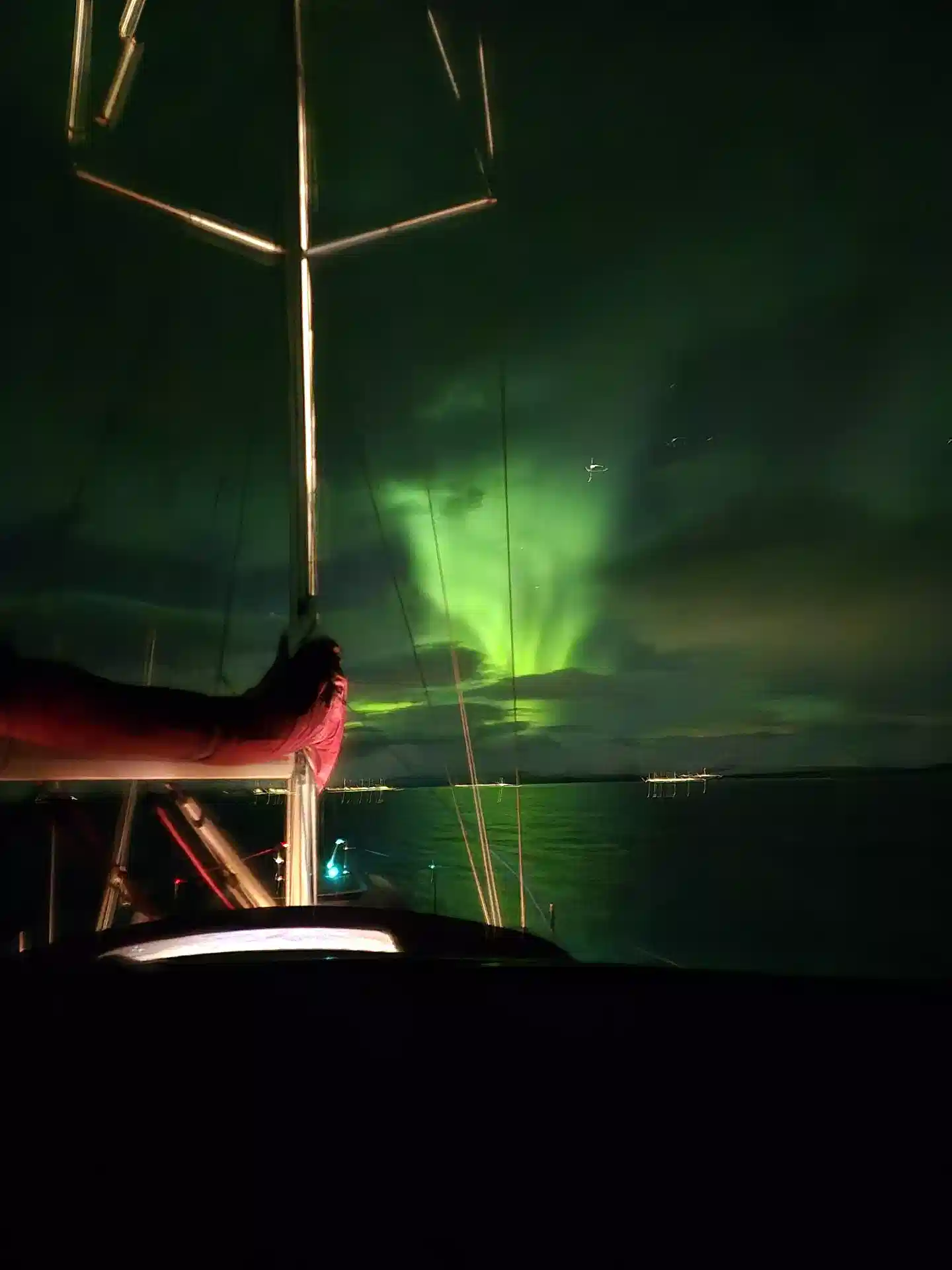
Each appearance of the northern lights is different — flickering curtains, rolling smoke, or a sudden corona overhead. The best viewing runs from September to March, when the Arctic night provides a dark sky. Tromsø sits in the middle of the aurora zone, with the lights visible on about two of every three clear nights during the season.
The aurora borealis is caused by charged particles from the sun colliding with gases in Earth's atmosphere. The characteristic green colour comes from oxygen atoms at around 100km altitude; red aurora occurs at higher altitudes, while nitrogen produces purple and blue hues.
Tromsø's location at 69°N places it directly under the auroral oval, the ring-shaped zone around the magnetic North Pole where aurora activity is most frequent.
Viewing the aurora from a yacht, anchored in a dark fjord away from town lighting, gives an unobstructed view stretching from horizon to horizon. Calm water reflects the display, and there is little ambient noise.
Photography tips: use a tripod, set ISO to 1600–3200, aperture to the widest available (f/2.8 or wider), and exposure time to 5–15 seconds. Manual focus set to infinity is essential. Modern smartphones with night mode can also capture good aurora images.
The best aurora forecasts combine solar wind data with local weather forecasts. Our crew monitors both and will wake guests if a strong display occurs during the night. Some of the strongest auroras happen after midnight, when the magnetic field is best aligned.
About the author
Boreal Yachting crew
Skippers and guides, Tromsø
Written by the Boreal Yachting editorial team using operational knowledge from the skippers and guides who sail Northern Norway and Svalbard.
Meet the crew