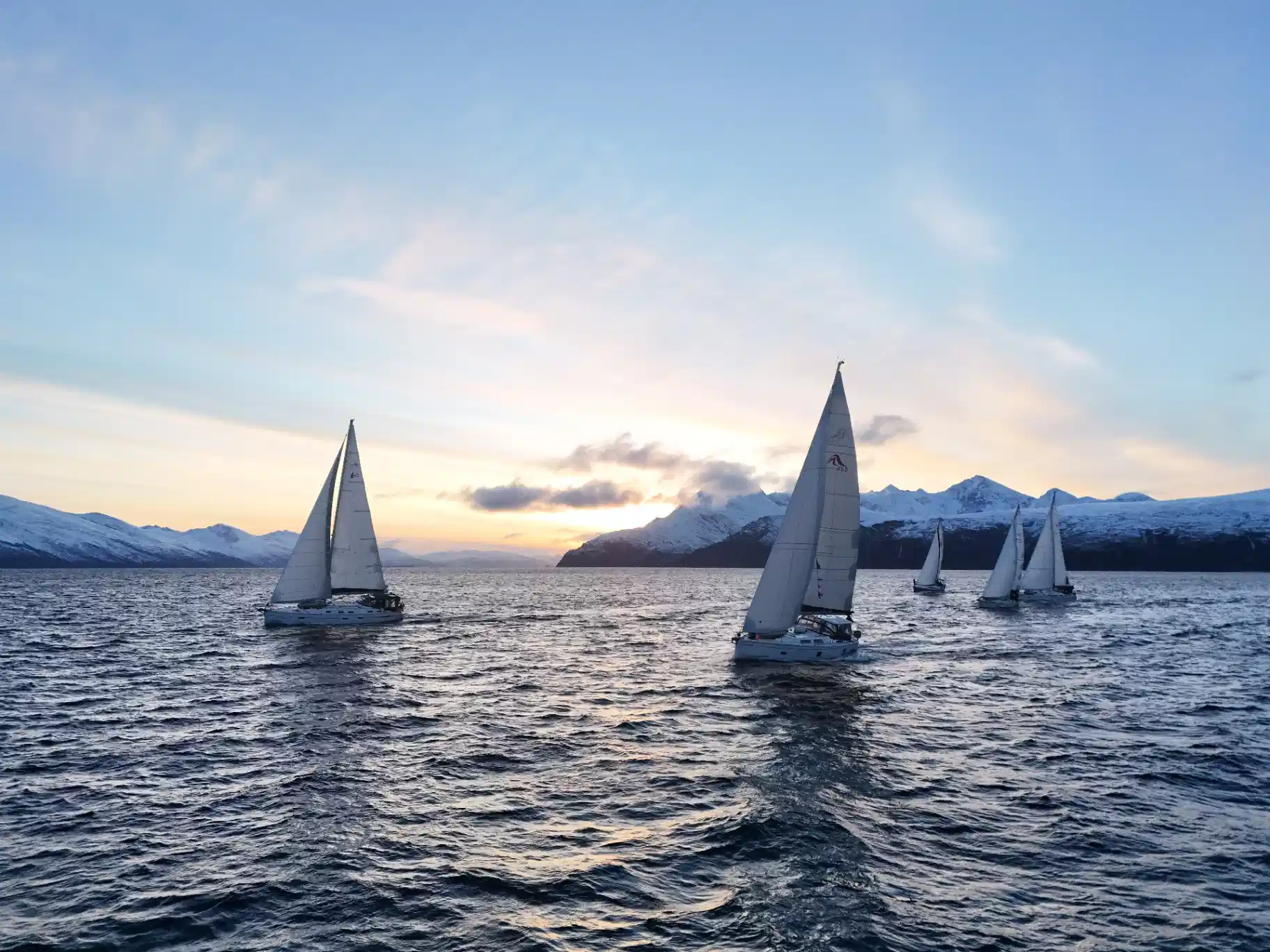
The Complete Guide
Best time to sail Northern Norway
Northern lights, midnight sun, Ski & Sail — a complete seasonal guide.
The best time to sail Northern Norway depends on the goal: October to March for the northern lights, late February to May for Ski & Sail, and May to August for the midnight sun and Svalbard. Boreal Yachting, an AECO member and Eco-Lighthouse certified operator based in Tromsø since 2003, runs whole-boat charters across all four seasons.
Last updated
This is the question we receive more than any other: when is the best time to sail in Northern Norway?
The honest answer is that there is no single best time — only the best time for what you want to experience. Northern Norway's sailing seasons are distinctly different from each other, and each one offers something the others cannot. A winter sailor pursuing the northern lights is in the wrong season if they show up in July. A family wanting the midnight sun will be disappointed in January.
This guide, based on twenty years of sailing every month of the year in these waters, gives you the complete picture.
When should you sail for the northern lights?
Sail between October and February for the northern lights, with October–November and February as the most reliable months for combining aurora activity and manageable weather.
What you get
Northern lights and dramatic Arctic darkness, with dawn around 10:00 and dusk before 15:00 in midwinter. Snow settles on the mountains and few other visitors are on the water. It is a particular, irreplaceable atmosphere.
The aurora borealis
Winter is the only season when you can see the northern lights, because it is the only season with sufficiently dark skies above the Arctic Circle. Tromsø sits at 69.6°N, inside the auroral oval. From a yacht at anchor the horizon is open in every direction and there is no light pollution, so the limiting factor is cloud rather than darkness.
The most active aurora months, combining good solar activity probability with manageable weather, are October–November and February. January is spectacular when clear, but the conditions can be challenging.
The sailing conditions
Winter sailing in Northern Norway is for experienced offshore sailors. Conditions can be harsh: temperatures well below zero, wind-driven spray that freezes on deck, short windows of daylight for navigation. Boreal offers skippered charter and guided experiences in winter; bareboat in winter is for very experienced Arctic sailors only.
Who should choose winter
- Anyone whose primary objective is the northern lights
- Photographers (low-angle winter light on clear days)
- Experienced offshore sailors comfortable in demanding conditions
- Travellers who value solitude and genuine Arctic atmosphere
When can you ski and sail in the Lyngen Alps?
The Ski & Sail season in the Lyngen Alps runs from late February to mid-May, with March and April as the peak months for long days and stable snow.
What you get
This is the Ski & Sail season, and many who have experienced it consider it the finest sailing period of the year. The days lengthen quickly: by late April there are more than fifteen hours of light. Snow conditions on the mountains are at their best, generally consolidated and reliable, and the sea is calmer as winter's storms abate.
Ski & Sail
The prime Ski & Sail season in the Lyngen Alps runs from late February through to mid-May. March and April are the most popular months: long days, stable snowpack, and a combination of snow conditions that range from spring corn to deep powder depending on aspect and recent weather. The Lofoten Ski & Sail season runs slightly earlier — February through to early April. Read the Lyngen Ski & Sail guide → See also what's included in Ski & Sail.
The northern lights
Spring equinox — late March — is statistically one of the most active periods for geomagnetic aurora activity. In a good year, March Ski & Sail trips in the Lyngen Alps offer both skiing by day and northern lights by night.
Who should choose spring
- Ski tourers and backcountry skiers — this is the primary Ski & Sail season
- Anyone wanting both skiing and a chance at northern lights in a single trip
- Sailors who want a full season of long days without yet reaching peak summer visitor numbers
When is the midnight sun season?
The midnight sun runs from mid-May to late July above the Arctic Circle, with continuous daylight at Tromsø from around 20 May to 22 July, making May to August the main season for Hike & Sail, bareboat and Svalbard charters.
What you get
The midnight sun. From mid-May, the sun does not set above the Arctic Circle. By late May in Tromsø, it is already above the horizon continuously, and by midsummer the daylight is complete: the sun circles the sky without setting. Read the midnight sun guide →
Summer is also the season of maximum wildlife activity, the warmest temperatures (12–18°C on good days), and the most active cruising period for bareboat sailors.
Hiking, sailing, and wildlife
Summer is Hike & Sail season: the peaks are snow-free, the trails are open, and the access to remote terrain from a yacht is at its easiest. It is also Svalbard expedition season — the only time of year when the ice conditions allow comfortable yacht access to the archipelago. See Hike & Sail →
Wildlife is at its peak: puffins breeding in the outer islands, sea eagles hunting the fjords, orcas and humpback whales possible in the northern waters, reindeer calves visible on hillsides from the deck.
Who should choose summer
- Families (the midnight sun and warm weather make this the most accessible season)
- Hikers and trekkers seeking Hike & Sail
- Anyone wanting to sail to Svalbard (June–August only)
- Bareboat sailors wanting the most manageable conditions and longest days
- Those specifically seeking the midnight sun experience
Is autumn a good time to sail Northern Norway?
Autumn, running September to October, is a good time to sail for quiet waters, autumn colours and the first northern lights of the season.
What you get
Autumn is one of Northern Norway's quietest and most rewarding seasons. The midnight sun has ended, the first northern lights are returning, and the birch forests on the hillsides turn gold, orange and red against the dark rock of the fjord walls. The water is still relatively warm, warmer than in spring, and there are few other visitors.
The overlap season
September in particular offers something rare: good sailing conditions, potential northern lights (the September equinox is another peak aurora month), autumn colours, and active wildlife including orcas following the herring. The combination suits photographers and anyone who values atmosphere over sunshine.
Who should choose autumn
- Photographers (autumn light and colour)
- Those who want northern lights without the depth of winter
- Experienced sailors who prefer quieter waters and fewer other boats
- Wildlife enthusiasts (autumn orca season in northern Norway)
Summary: season by priority
Northern lights
October–March. Peak: October–November, February–March.
Ski & Sail
February–May. Peak: March–April (Lyngen), February–March (Lofoten).
Svalbard expedition
June–August only.
Midnight sun
Mid-May to late July. Peak: June–July.
Hike & Sail
June–September. Peak: July–August.
Bareboat charter
May–September. Peak: June–August.
Mountainbike & Sail
June–September.
Wildlife viewing
Year-round (varies by species). Puffins: June–July. Orcas: October–January. Polar bears (Svalbard): June–August.
Photography
October–November (northern lights + autumn light). February–March (ski + aurora). June–July (midnight sun).
Plan your Northern Norway sailing trip
- → Tell us your preferred season and primary interest
- → We'll recommend the right product and destination
- → Ski & Sail and Svalbard fill early — enquire as soon as you have a year in mind
- → Contact us — post@boreal-yachting.com | +47 77 72 92 00
Start planning your Arctic journey.
Tell us what you have in mind. We will come back to you within two working days with a considered answer — not a template.