The Complete Guide
Sailing Under the Midnight Sun
Norway's 24-hour Arctic summer — Lofoten, Tromsø and Svalbard from a sailing yacht.
Midnight sun sailing in Norway means cruising Lofoten, the Tromsø archipelago and Svalbard through continuous Arctic daylight, from roughly 20 May to 22 July at Tromsø's latitude of 69.6°N. Boreal Yachting, an AECO member and Eco-Lighthouse certified operator sailing these waters since 2003, runs whole-boat charters through this season for hiking, wildlife-watching and family cruising.
Last updated
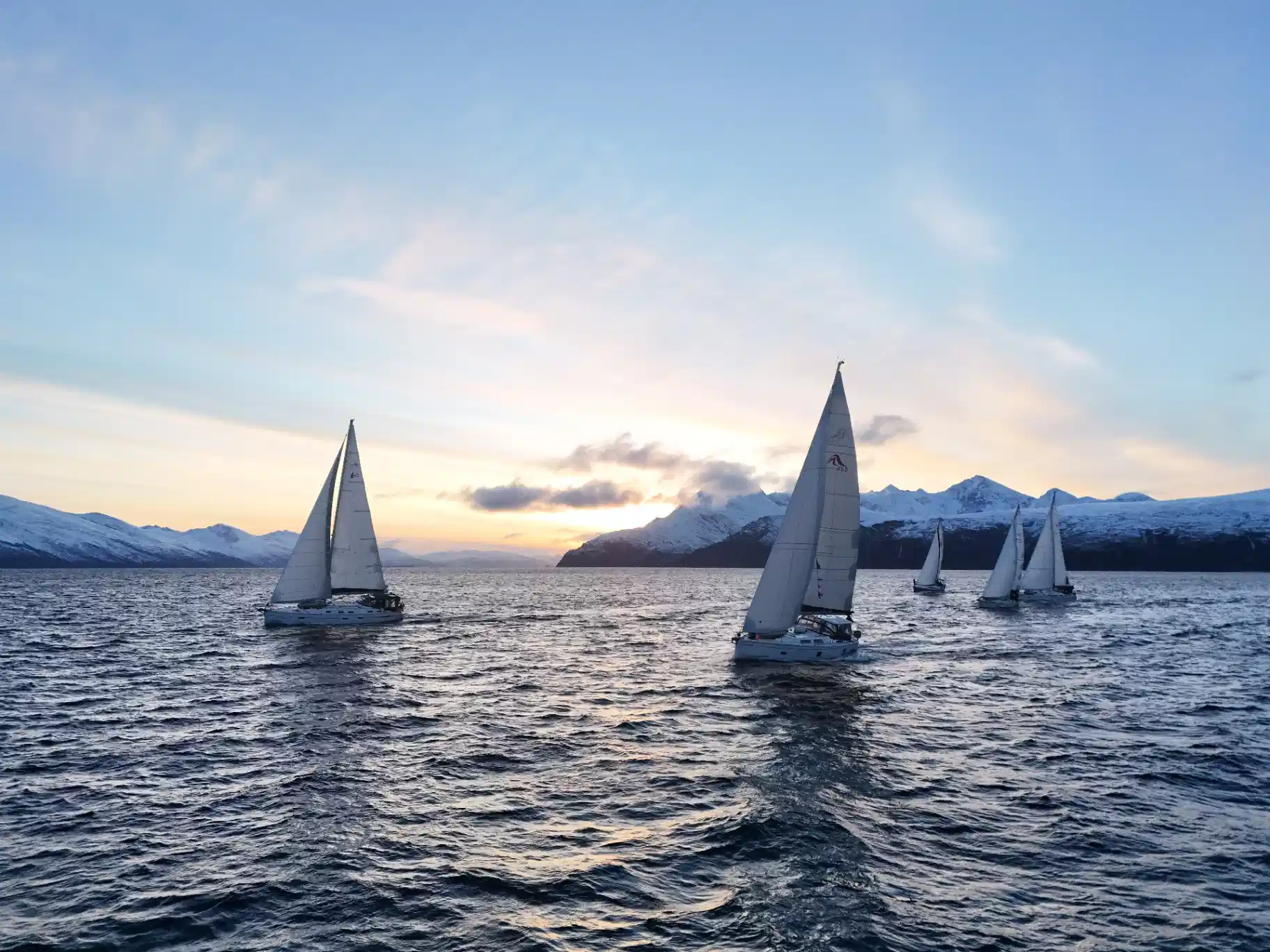
At 2:30 in the morning, somewhere in the Lofoten Islands, you are sitting in the cockpit of a sailing yacht. The mountains are lit in orange and gold. The water is completely calm. A sea eagle circles above the ridge to the north. And the sun, which has been above the horizon since early May and will not set again until late July, sits low and warm on the northwestern horizon, casting the longest shadow you have ever seen.
This is the midnight sun. Not as a concept, not as a time-zone anomaly, but as a lived reality: a world where the normal rules of day and night no longer apply, where you can hike at midnight, swim at 1 AM, watch the fjord change colour through sixteen shades of gold between 11 PM and 3 AM, and feel, in some fundamental way, that the world has been reorganised around light rather than time.
Sailing is the finest way to experience the midnight sun. This page tells you why, and what to expect.
What is the midnight sun?
The midnight sun is a natural phenomenon that occurs above the Arctic Circle (66.5°N) when the Earth's axial tilt keeps the sun continuously above the horizon during the polar summer. At Tromsø (69.6°N), the midnight sun lasts from approximately 20 May to 22 July — over two months of continuous daylight. At Svalbard (78°N), it runs from approximately 19 April to 23 August.
During this period, there is no true darkness. The sun arcs around the sky, dipping toward the northern horizon in the small hours but never actually setting. At its lowest, it produces the quality of light that landscape photographers call the golden hour — but this 'golden hour' lasts four to six hours, concentrated around midnight.
Why is sailing a good way to see the midnight sun?
Sailing suits the midnight sun because a yacht keeps you outdoors and mobile through the night, on the water where the low light is most dramatic, ready for anything that happens at 1 a.m. Four reasons follow.
You are never asleep when something happens. On a yacht, when the midnight sun produces something special at 1 AM — an unexpected golden light on a particular mountain, a whale surfacing off the bow — you are already there.
The water doubles everything. The reflection of midnight sun light in a glassy fjord creates a world in which the sky and the sea are equally lit, the mountains are perfectly mirrored, and the sense of being surrounded by light is total.
You can actually use the hours. A yacht at anchor at 11 PM with 18°C air temperature and full daylight is an ideal place to be awake. You can hike to a peak at midnight (it has been done, and it is one of those experiences guests bring up for years afterwards). You can fish. You can kayak.
The light is best from the water. The midnight sun light, at its low angle, hits the mountain faces in a way that is most dramatic from sea level. The mountains glow. From a boat, you see the full face of the mountain in that light, without obstruction.
Where and when can you sail under the midnight sun?
Lofoten and the Tromsø archipelago see the midnight sun from May to July, while Svalbard's season runs into August, as detailed below.
Lofoten: June to July
The Lofoten archipelago is perhaps the world's finest setting for midnight sun photography and experience. The jagged peaks, the red rorbuer, the reflections in the still water of the inner sounds — all of this in the continuous warm light of the Arctic summer. June and early July are the quietest months before the height of tourist season, making sailing particularly good. Read the Lofoten destination guide →
Tromsø archipelago: May to late July
The islands around Tromsø catch the midnight sun earlier than Lofoten and in a less-visited environment. A bareboat or skippered week in the Tromsø archipelago in June gives the midnight sun experience with very few other boats and a wide diversity of anchorages. Explore the Tromsø destination →
Svalbard: May to August
Svalbard's midnight sun season is the longest in the accessible Arctic. An expedition here in June or July means weeks of continuous light, wildlife active around the clock (polar bears included), and the particular atmosphere of a landscape that is truly polar even in summer. See the Svalbard sailing expedition →
What should you know before sailing in continuous daylight?
Blackout blinds, layered clothing and sun protection matter more than a summer holiday elsewhere would suggest, covering sleep, temperature, weather, wildlife and fishing below.
Sleep
Cabin windows should have blackout blinds — Boreal's boats have them. Most guests adapt to sleeping in daylight within two or three nights.
Temperature
June–August average temperatures in Tromsø/Lofoten: 12–18°C daytime, 8–12°C at night. Warm by Arctic standards.
Weather
Norwegian summer weather is generally good but changeable. Rain is possible at any time; clear days are common.
Wildlife
Seabirds are active 24 hours. Sea eagles, puffins (June–July), porpoises, occasional whales. Reindeer on hillsides visible from the boat.
Fishing
Excellent. Cod, saithe, halibut. The 24-hour daylight does not affect fishing; many species are active and feeding.
A midnight sun moment
We anchored in a cove on the south side of Moskenesøya at ten in the evening. By midnight the light had turned completely gold and the mountains were reflected in the water without a single ripple. There were three of us sitting on deck and none of us said anything for a long time. There was nothing to say. It was simply the most extraordinary light any of us had ever been in.
How far in advance should you book?
The midnight sun season is Boreal Yachting's busiest period. Bareboat and skippered slots fill six to twelve months in advance. If you have a specific week in July in mind, enquire early.
Sail under the midnight sun with Boreal Yachting
- → Season: mid-May to late July (varies by destination)
- → Destinations: Lofoten, Tromsø archipelago, Svalbard
- → Bareboat, skippered, and guided options available
- → Whole-boat charter vs group departure — how booking works
- → Contact us — post@boreal-yachting.com | +47 77 72 92 00
Start planning your Arctic journey.
Tell us what you have in mind. We will come back to you within two working days with a considered answer — not a template.